


Matthieu Acosta
Flamenco guitarist & composer
Story of a guitarist
A child of an Aruban father and a Dutch mother, born in the city of Rotterdam on the 17th of december 1989, Matthieu Acosta was never defined by a single people or culture. Growing up within a family of guitarists, music and particularly the guitar have always played a central role in his life. Showing promise at an early age during his classical guitar training, he discovered flamenco at age 14 through the wonderful music of Paco de Lucía. Due to his sister studying classical guitar at the conservatory of Rotterdam 'Codarts' at the time, he had the good fortune of meeting Ricardo Mendeville, one of the flamenco guitar teachers at Codarts, who helped him on his path to discover flamenco. Matthieu decided to audition that same year for the junior highschool program of Codarts and got accepted. This allowed him to study under the tutalage of the great master Paco Peña from an early age throughout the different programmes found at Codarts (HMD, Prepatory, Bachelor, Master).
Through Paco Peña, Matthieu has learned flamenco in a very honest and profound way by being taught to be very selfaware and respectful towards the traditional elements of flamenco. Making this way of viewing and playing flamenco his own, it has provided Matthieu with a compass for his own musical ideas without disregarding the rich tradition in which this music finds its origin. This is why he regards Paco not only as a great guitarist, teacher, and mentor but as one of the pillars of his artistic life as well.
Matthieu Acosta is always searching for new ways to develop himself artistically to better expres his musical ideas and achieve a sound on the guitar to allow these ideas to be heard. A sound that has often been characterised as being strong, clear, full and round. With his virtuosic playing he's constantly searching for new paths to discover whilst staying true to the path that's called flamenco. In a world where access and inspiration to other musics can be found so easily, staying true to fundemental elements of flamenco is increasingly important. Elements that can be found most in the singing and dance and the accompaniment of it. In between a multicultural background, a globalising world and a love for traditional flamenco is where the voice of Matthieu can be heard.
Gallery
Thoughts & Memories
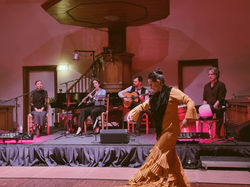 |  |  |  |  |  |
|---|---|---|---|---|---|
 |  |  |  |  |  |
 |  |  |  |  |  |
 |  |  |  |  |  |
 |
Videos
Impressions
Videos
Videos

Matthieu Acosta Flamenco Trio & Irene Álvarez
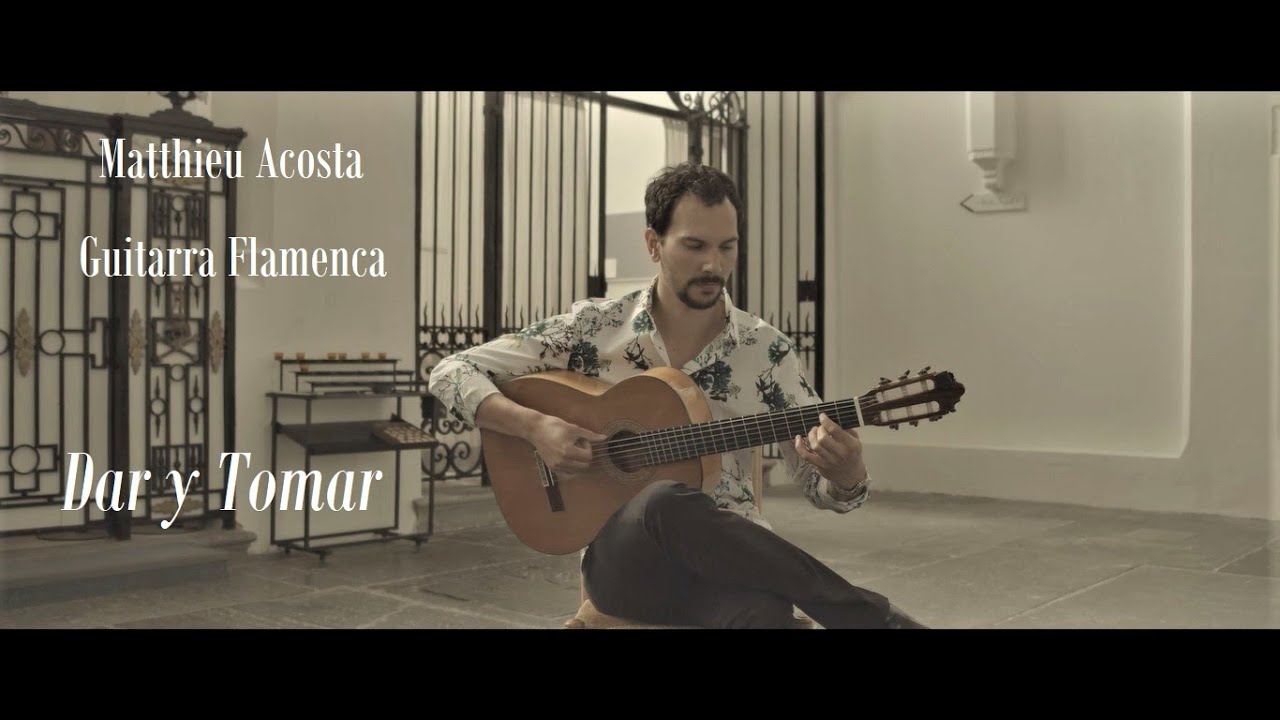
Flamenco Guitar - Matthieu Acosta - Dar y Tomar (Colombianas)

Dos Islas (Tangos) - Matthieu Acosta Trio - Flamenco

Quinteto Matthieu Acosta ft. Irene Álvarez | ‘Equilibrio’
Concerts
- Matthieu Acosta Trio at the VAK Delftdi 20 janVAK Delft
- Solo Concert at Bekroond in Blauwzo 22 febBergen
- Matthieu Acosta Trio at the Stichting Kunst en Cultuur Aalsmeerza 11 aprAalsmeer
- Matthieu Acosta Trio at the Van Cappellenhuisvr 08 meiCapelle aan den IJssel
- Duo Flamenco guitar & Flutewo 29 julOostkapelle
- Duo Flamenco guitar & Flutewo 09 sepOost-Vlieland
